
How to Create an Irresistible Offer That Sells Without Discounting Your Price
If you’ve ever launched a product, run an advertising campaign, promoted a service, or opened a business and heard silence instead of sales, you may have assumed the problem was your price.
Or your product.
Or your website.
Or perhaps you thought you simply needed more traffic.
Sometimes those things are the problem.
But very often, there is another issue hiding underneath them:
Your offer isn’t strong enough.
And that’s important because your offer is one of the most powerful—and frequently overlooked—levers in marketing.
Your offer is not simply the product or service you sell.
It is how you package, position, communicate, and present that product or service so that your ideal customer sees enough value to take action.
Two businesses can sell almost the same service at almost the same price and achieve completely different results because one has created a much stronger offer.
A weak offer forces you to fight harder for every sale.
A strong offer can make your advertising more effective, your sales conversations easier, your landing pages more persuasive, and your business less dependent on discounts.
And you don’t necessarily need to lower your price to create one.
In this guide, I’ll show you how to create an irresistible offer using a practical six-part framework that can be applied to products, services, consulting, agencies, retail businesses, SaaS companies, local businesses, and many other industries.
Table of Contents
- What Is an Offer?
- Why Your Offer Should Come Before More Marketing
- Why Competing on Price Is a Dangerous Strategy
- The Psychology Behind Buying Decisions
- The 6-Part Framework for Creating an Irresistible Offer
- Customer Avatar
- Core Transformation
- Value Proposition
- Bonuses
- Price & Payment Terms
- Urgency & Scarcity
- How the Six Components Work Together
- Common Offer-Creation Mistakes
- Best Practices for Creating Better Offers
- Expert Tips for Improving Your Offer
- Frequently Asked Questions
- Key Takeaways
- Conclusion
1. What Is an Offer? And Why Isn’t It the Same as Your Product?
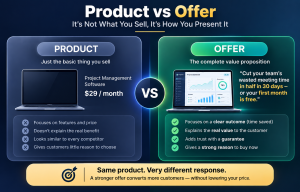
One of the biggest marketing mistakes business owners make is treating their product and their offer as the same thing.
They aren’t.
Your product or service is what you sell.
Your offer is the complete proposition the customer evaluates when deciding whether buying from you makes sense.
That includes things such as:
- The problem you promise to solve
- The result or transformation you communicate
- Who the solution is designed for
- What is included
- Why your solution is different
- Additional bonuses
- Pricing and payment structure
- Guarantees or risk reversal
- Reasons to take action now
- The way all of that information is presented
For example, imagine a software company saying:
“Project management software — $29/month.”
Technically, that is something a customer can buy.
But compare it with:
“Cut unnecessary team meetings and bring every project, deadline, and conversation into one workspace. Get your entire team set up in less than an hour, with your first month protected by our satisfaction guarantee.”
The underlying product could be very similar.
But the second version communicates much more value.
It connects the product with a desirable outcome.
It makes the solution easier to understand.
And it reduces some of the uncertainty associated with buying.
That’s the power of the offer.
Customers Can’t Fully Evaluate Quality Before Buying
This distinction matters because customers often cannot accurately judge the real quality of a product or service before experiencing it.
But they can evaluate how clearly you communicate:
- What they’ll receive
- What result they can expect
- Why it matters
- Why they should trust you
- Why they should choose you instead of an alternative
Your offer therefore becomes a bridge between the value your business can provide and the value the customer can perceive before making a purchase.
But there is an important second half to this equation:
You still have to deliver what you promise.
A compelling offer may generate the first sale.
Consistent delivery creates the second, third, and tenth sale.
A useful way to think about it is:
Strong Offer + Strong Delivery = Higher Conversion + Customer Retention + Brand Equity
While:
Strong Offer + Poor Delivery = Disappointed Customers + Lost Trust + Brand Damage
Marketing can accelerate demand.
But it can also accelerate negative word of mouth when the customer experience doesn’t match the promise.
2. Why Your Offer Should Come Before More Marketing
When sales are slow, businesses often react by trying to increase traffic.
They increase their advertising budget.
Post more frequently on social media.
Hire another salesperson.
Redesign their website.
Launch another campaign.
All of those things can help.
But they become expensive when the underlying offer isn’t compelling.
Think about it this way.
If 1,000 people see your offer and only 10 buy, increasing traffic to 2,000 people might produce 20 sales.
But if improving the offer increases your conversion rate from 1% to 2%, those same 1,000 visitors could already generate 20 customers.
That’s why improving the offer should often come before scaling traffic.
A strong offer can:
- Differentiate you from similar competitors
- Make advertising more effective
- Increase perceived value
- Improve landing-page conversion
- Give customers a clearer reason to buy
- Reduce hesitation
- Make sales conversations easier
- Improve return on marketing investment
- Reduce dependency on price promotions
Practical Application
Before increasing your advertising budget, ask:
“If twice as many qualified people saw this exact offer tomorrow, would I be confident that it would convert them?”
If the answer is no, increasing your ad spend may simply mean paying to expose more people to a weak proposition.
Fix the offer first.
Then scale what works.
3. Why Competing on Price Is a Dangerous Strategy
Lowering your price is one of the fastest ways to increase the attractiveness of an offer.
It’s also one of the easiest strategies for competitors to copy.
That’s the problem.
Imagine two competing businesses.
Business A lowers its price by 10%.
Business B reacts and lowers its price by 15%.
Business A responds with 20%.
Eventually, both businesses have trained customers to compare them primarily on price.
Margins shrink.
Service quality becomes harder to maintain.
Marketing budgets disappear.
And the business with the deepest pockets—or lowest costs—usually wins.
This is the classic race to the bottom.
A Better Alternative: Increase Perceived Value
Instead of immediately asking:
“How can we make this cheaper?”
Ask:
“How can we make buying this feel more valuable, easier, safer, faster, or more convenient?”
You could improve the offer through:
- Better packaging
- Faster implementation
- Added services
- Bonuses
- Better onboarding
- Flexible payment terms
- Guarantees
- Improved support
- Greater convenience
- Stronger positioning
- Clearer differentiation
Imagine three gyms operating in the same area.
Two compete by constantly discounting memberships.
The third charges more but includes:
- A personalized fitness assessment
- A structured onboarding program
- Monthly progress reviews
- Nutrition guidance
- Member-only community events
- A satisfaction guarantee
Which gym has the strongest reason to exist beyond price?
The third.
Customers aren’t evaluating only the membership fee anymore.
They’re evaluating the complete value of the offer.
Best Practice
Compete on value before competing on price.
Price is easy for competitors to copy.
A thoughtfully designed customer experience is much harder to replicate.
4. The Psychology Behind Every Buying Decision
People like to believe purchasing decisions are rational.
In reality, many decisions begin emotionally and are justified logically afterward.
Customers don’t simply buy features.
They buy what those features allow them to experience, achieve, avoid, become, or feel.
Someone purchasing accounting software might say they chose it because:
- It automates invoicing
- It integrates with their bank
- It creates reports automatically
Those are rational reasons.
But underneath them may be stronger emotional motivations:
- “I don’t want to worry about my finances anymore.”
- “I want to feel in control of my business.”
- “I don’t want another tax-season nightmare.”
- “I want to know whether I’m actually making money.”
The feature matters because of the outcome it creates.
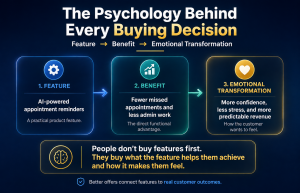
Features → Benefits → Transformation
A simple framework for translating features into stronger marketing is:
Feature → Functional Benefit → Emotional Outcome
For example:
Feature: Automated appointment reminders
Functional benefit: Fewer missed appointments
Emotional outcome: Less frustration and more predictable revenue
Or:
Feature: Same-day delivery
Functional benefit: The customer gets the product quickly
Emotional outcome: Convenience, certainty, and relief
The further your messaging moves toward the meaningful customer outcome—without becoming exaggerated—the more powerful it becomes.
Sell the Outcome, Then Support It With Logic
Your headline or primary message should often communicate the desired outcome.
Then use features, specifications, evidence, methodology, testimonials, and details to logically support that promise.
5. The 6-Part Framework for Creating an Irresistible Offer
Now we reach the core of the process.
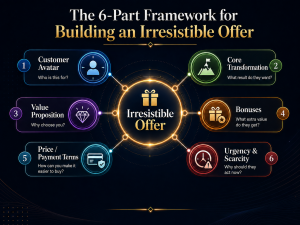
A strong marketing offer can be built around six interconnected components:
- Customer Avatar
- Core Transformation
- Value Proposition
- Bonuses
- Price & Payment Terms
- Urgency & Scarcity
Think of these six elements as an offer stack.
The stronger they work together, the more compelling your proposition becomes.
5.1 Customer Avatar: Who Is This Offer Specifically For?
Your first task is identifying exactly who you are trying to convince.
This is often called your:
- Customer avatar
- Buyer persona
- Ideal customer profile
- Target customer
The terminology matters less than the clarity.
A weak definition might be:
“Small business owners.”
That’s too broad.
A much stronger definition could be:
“Owner-operated service businesses generating $3,000–$8,000 per month that rely primarily on referrals and struggle to generate consistent qualified leads.”
Now you have something useful.
You can begin understanding:
- What keeps them awake at night
- What they have already tried
- What objections they have
- What result matters most
- What language they naturally use
- What they consider expensive
- What they consider valuable
- What would make them take action
Questions to Answer
Your customer avatar should help you understand:
Demographics
- Age
- Location
- Occupation
- Income or business revenue
- Business type
Problems
- What frustrates them?
- What repeatedly goes wrong?
- What does the problem cost them?
Goals
- What result are they trying to achieve?
- What would success look like?
Objections
- Why haven’t they solved the problem already?
- What makes them hesitate before buying?
Aspirations
- What do they ultimately want their business or life to look like?
The clearer your customer, the easier every remaining part of your offer becomes.
5.2 Core Transformation: What Result Are You Really Selling?
Next, define the result your customer actually wants.
Your customer usually isn’t buying the mechanism.
They’re buying the transformation.
A meal-prep business might technically sell prepared food.
But what customers may really want is:
“Healthy weekday dinners without spending an hour cooking every night.”
A digital marketing consultant may technically provide:
- SEO
- Advertising
- Analytics
- Funnels
- Automation
But the SME owner may actually want:
“A predictable system for generating more qualified customers without depending entirely on referrals.”
That’s the transformation.
Ask This Question
“If my customer gets everything they want from this product or service, what changes in their life or business?”
Your answer should become one of the central components of your offer.
5.3 Value Proposition: Why Should Customers Choose You?
Once you’ve defined the transformation, you need to answer the next question:
Why should they choose you instead of another option?
This is your value proposition.
Unfortunately, many businesses answer with statements such as:
- High quality
- Affordable price
- Great service
- Customer satisfaction
- Professional team
- Years of experience
Those aren’t necessarily bad attributes.
They’re simply difficult to own because almost every competitor can say the same thing.
A strong value proposition is usually more:
- Specific
- Relevant
- Meaningful
- Differentiated
- Credible
- Defensible
Compare:
“We provide excellent bakery delivery service.”
with:
“Fresh custom cakes delivered anywhere in the city within two hours of completion.”
The second statement communicates something concrete.
Useful Value Proposition Formula
Try:
We help [specific customer] achieve [specific result] through [unique mechanism/difference] without [major pain or objection].
For example:
“We help local service businesses build predictable lead-generation systems using AI, digital marketing, and data analytics—without relying entirely on referrals or guesswork.”
Clarity beats cleverness.
5.4 Bonuses: Increase Value Without Reducing Your Price
Bonuses are one of the easiest ways to increase perceived value without lowering your core price.
The key is relevance.
A good bonus should help the customer:
- Get results faster
- Overcome an obstacle
- Use the core product successfully
- Reduce implementation effort
- Increase convenience
- Avoid an additional expense
Suppose you sell an online marketing course.
Instead of discounting the course from $500 to $350, you could keep the $500 price and add:
- Advertising templates
- Content calendar
- Landing-page checklist
- AI prompt library
- Private community access
- Monthly implementation session
The customer now evaluates the entire package, rather than simply the course price.
The Best Bonuses Solve the Next Problem
Ask:
“After buying my core product, what is the next obstacle the customer will face?”
Turn the solution to that obstacle into a bonus.
This creates a more complete path to the desired result.
5.5 Price and Payment Terms: Make the Decision Easier
You don’t always need to reduce the price.
Sometimes you simply need to reduce the friction associated with paying it.
Imagine a $1,200 consulting program.
Option A:
$1,200 upfront
Option B:
3 monthly payments of $400
The total value is identical.
But the second option may feel financially easier for some customers.
Depending on your business model, you might consider:
- Installment plans
- Deposits
- Milestone payments
- Monthly billing
- Annual payment options
- Pay-in-full incentives
- Free trials
- Paid trials
- Usage-based pricing
- Tiered packages
The purpose isn’t to hide the real price.
The purpose is to align the payment structure with how customers prefer or are able to buy.
Important
Flexible payments should improve accessibility—not encourage customers to purchase something they cannot reasonably afford.
Long-term trust matters more than extracting a single transaction.
5.6 Urgency and Scarcity: Why Should They Act Now?
A customer might love your offer and still say:
“I’ll think about it.”
And “I’ll think about it” often turns into “maybe later.”
Then “later” becomes never.
That’s where urgency and scarcity can help.
Urgency answers:
Why should I act now?
Scarcity answers:
Why might this opportunity not remain available indefinitely?
Examples of legitimate urgency include:
- Enrollment closes Friday
- Early-registration bonuses expire on a specific date
- Seasonal service availability
- An upcoming event deadline
Examples of legitimate scarcity include:
- Only 10 implementation slots per month
- Limited inventory
- Limited event dates
- Small cohort capacity
- Geographic service limitations
For example:
“We onboard a maximum of 10 new clients each month so every account receives sufficient strategy and implementation support.”
That’s believable when the capacity limit is real.
Avoid Fake Scarcity
Avoid:
- Countdown timers that endlessly reset
- “Only two left!” when inventory is unlimited
- Fake deadlines
- Constant “final chance” emails
- Invented capacity restrictions
False urgency might generate a short-term conversion.
But it can damage the trust your brand needs for long-term growth.
6. How the Six Components Work Together
An irresistible offer isn’t created by maximizing one component.
It’s created by making the components reinforce each other.
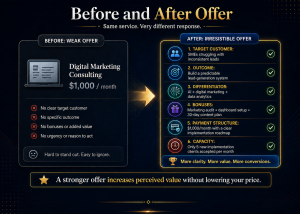
Consider this hypothetical example.
Weak Offer
Digital marketing consulting — $1,000/month.
There is nothing inherently wrong with it.
But there’s very little reason to choose it.
Now apply the framework.
Stronger Offer
Customer Avatar: Local service businesses generating consistent revenue but struggling with unpredictable lead flow.
Transformation: Build a predictable customer-acquisition system.
Value Proposition: Combine AI, digital marketing, and analytics to identify what actually drives profitable leads.
Bonuses: Marketing audit + dashboard setup + 30-day content framework.
Payment Terms: Monthly engagement with a clearly defined initial implementation phase.
Scarcity: Maximum of five new implementation clients accepted each month.
The underlying consulting service may not have fundamentally changed.
But the customer’s perception of the proposition certainly has.
That is offer strategy.
7. Common Mistakes Business Owners Make When Creating Offers
Understanding the framework is useful.
Avoiding these mistakes is equally important.
Mistake #1: Confusing a Discount With an Offer
A discount is one possible component of an offer.
It isn’t the offer itself.
Before reducing your price, explore whether you can improve:
- Positioning
- Packaging
- Bonuses
- Guarantees
- Payment structure
- Convenience
- Support
- Delivery speed
Mistake #2: Trying to Appeal to Everyone
When your offer is designed for everyone, the messaging usually becomes too generic to strongly resonate with anyone.
Specific offers are easier for customers to recognize as relevant.
Mistake #3: Leading With Features
Customers need features.
But features become persuasive when customers understand the outcome behind them.
Translate features into benefits and transformations.
Mistake #4: Using Fake Urgency
Manipulative scarcity destroys trust.
If the deadline isn’t real, don’t invent one.
Mistake #5: Adding Irrelevant Bonuses
Ten random bonuses don’t necessarily make an offer stronger.
Three highly relevant bonuses can be far more valuable.
Mistake #6: Making an Unrealistic Promise
A promise that converts exceptionally well but cannot consistently be delivered is not a strong offer.
It’s a future reputation problem.
Mistake #7: Making the Offer Too Complicated
If prospects need 20 minutes to understand what they’re buying, there is probably too much complexity.
A sophisticated service can still have a simple proposition.
8. Best Practices for Creating Better Offers
When building your next offer, follow these principles.
Start With the Customer
Don’t begin by asking:
“What should we sell?”
Start with:
“What does our customer desperately want solved?”
Lead With the Transformation
Communicate the result before explaining the process.
Increase Value Before Reducing Price
Ask what can be added, packaged, improved, guaranteed, simplified, or made more convenient before discounting.
Remove Risk Where Appropriate
Depending on your industry, this might include:
- Free trials
- Satisfaction guarantees
- Clear cancellation policies
- Transparent deliverables
- Demonstrations
- Case studies
- Proof of previous results
Make Buying Frictionless
Confusing purchasing processes kill otherwise strong offers.
Make the next step obvious.
Make Urgency Real
If there isn’t a genuine reason to act immediately, don’t manufacture one.
Test the Offer
Your first version probably won’t be your best version.
Test:
- Headlines
- Value propositions
- Bonuses
- Packages
- Pricing presentation
- Guarantees
- Calls to action
- Offer positioning
A product might take months or years to redesign.
An offer can sometimes be improved within days.
That’s why offer optimization can be such a powerful growth lever.
9. Expert Tips for Improving Your Offer
Run the 10-Second Test
Show your offer to someone who doesn’t know your business.
Give them ten seconds.
Then ask:
- Who is this for?
- What will they get?
- What problem does it solve?
- Why is it different?
If they can’t answer the first two questions, your offer probably isn’t clear enough.
Bundle Instead of Discounting
Before lowering the price, try bundling complementary services or products.
You protect your positioning while increasing perceived value.
Improve the Offer Before Increasing Ad Spend
When paid campaigns underperform, don’t automatically blame the targeting or advertising platform.
Review the offer itself.
No advertising algorithm can permanently rescue a proposition customers don’t want.
Study Objections
Sales calls, WhatsApp messages, emails, reviews, customer-service conversations, and lost deals are all valuable sources of offer intelligence.
Repeated objections tell you where your offer needs improvement.
For example:
“It’s too risky.”
Add stronger proof or appropriate risk reversal.
“It’s too expensive.”
Improve value communication or payment terms.
“I don’t know whether this will work for my business.”
Add industry-specific examples, case studies, or qualification criteria.
Measure Delivery, Not Just Conversion
A high-converting offer isn’t automatically a successful offer.
Watch:
- Repeat purchase rate
- Retention
- Refund rate
- Customer satisfaction
- Referrals
- Reviews
- Lifetime value
These metrics tell you whether the experience actually matches the promise.
10. Frequently Asked Questions
Is an offer the same as a discount?
No.
A discount reduces the price of something you’re already selling.
An offer is the complete package and proposition presented to the customer. It can include positioning, bonuses, guarantees, payment terms, bundles, additional support, urgency, scarcity, or a discount.
Many excellent offers require no discount at all.
How do I create an irresistible offer for a small business?
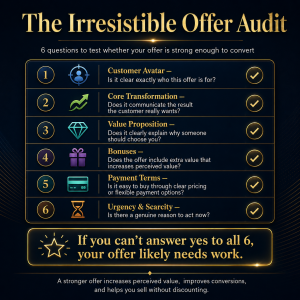
Start by defining your ideal customer and their most important desired outcome.
Then create your offer around six components:
- Customer Avatar
- Core Transformation
- Value Proposition
- Bonuses
- Price and Payment Terms
- Urgency and Scarcity
The goal is to make the value clear enough that the right customer’s purchasing decision becomes easier.
How can I increase perceived value without lowering my prices?
Consider adding relevant bonuses, improving packaging, creating flexible payment options, providing stronger guarantees, simplifying implementation, offering better onboarding, or communicating the desired transformation more clearly.
How often should I change my offer?
You should test elements of your offer regularly, but avoid changing the fundamental promise so frequently that customers become confused.
Test one significant variable at a time where possible and use actual conversion and customer-quality data to guide decisions.
What if I don’t have a big budget for bonuses?
Bonuses don’t have to be expensive.
Digital resources such as:
- Templates
- Checklists
- Guides
- Training
- Implementation plans
- Calculators
- Worksheets
can have high perceived value while costing relatively little to deliver repeatedly.
The key is relevance.
Is urgency manipulative?
Not when it’s genuine.
A real enrollment deadline, limited service capacity, fixed event date, or inventory restriction gives customers useful information.
It becomes manipulative when the limitation is invented simply to pressure someone into buying.
Does this framework work for service businesses?
Yes.
In fact, offer strategy is especially important for services because customers often find it difficult to compare intangible services before purchasing them.
Consultants, agencies, coaches, freelancers, local service providers, professional firms, and other service businesses can all use the same six-part framework.
Can a strong offer fix a bad product?
No.
A strong offer can increase initial conversions.
It cannot compensate indefinitely for poor delivery.
If the product or service consistently fails to deliver what was promised, a stronger offer may actually accelerate negative reviews and reputation damage.
11. Key Takeaways
If you remember nothing else from this guide, remember these principles:
- Your offer is not your product. It is how your product or service is packaged, positioned, and presented.
- Improve the offer before automatically increasing marketing spend.
- Competing purely on price is difficult to sustain.
- Increase perceived value before reducing price.
- Customers care about outcomes more than features alone.
- Start with a specific Customer Avatar.
- Communicate the transformation clearly.
- Create a defensible value proposition.
- Use relevant bonuses to strengthen the package.
- Payment terms can reduce purchasing friction without reducing your price.
- Urgency and scarcity should always be genuine.
- A compelling promise must be supported by excellent delivery.
The six-part framework is:
Customer Avatar → Core Transformation → Value Proposition → Bonuses → Price & Payment Terms → Urgency & Scarcity
Conclusion: Don’t Automatically Lower Your Price. Build a Better Offer.
When sales slow down, the instinct is often to chase more traffic.
More advertising.
More content.
More promotions.
Or lower prices.
But sometimes the real problem isn’t how many people see your business.
It’s what you’re asking them to say yes to.
A stronger offer can improve almost everything that comes after it:
Your ads become more persuasive.
Your website becomes clearer.
Your sales conversations become easier.
Your business becomes easier to differentiate.
And customers have a stronger reason to choose you without forcing you into an endless discounting cycle.
You don’t necessarily need a bigger marketing budget.
You may simply need a better offer.
Want to Know Whether Your Current Offer Is Strong Enough?
If you’re a small or medium-sized business owner and you’re struggling with inconsistent leads, low conversion rates, unclear positioning, or marketing that isn’t translating into enough revenue, I can help you identify where the problem is.
At DigiPranil, I help SMEs use AI, digital marketing, and data-driven strategies to create more effective marketing and sustainable revenue growth.
Want me to audit your current offer using the six-part framework from this guide?